
Marconi Technologies
Product engineering for NYC's leading life-safety communications manufacturer — power systems, embedded platforms, and new product lines for buildings where system failure is a safety event. Active engagement.

Marconi Technologies is a New York City-based manufacturer of life-safety communication systems. Their equipment goes into buildings where emergency radio failure isn’t an inconvenience — it’s a firefighter who can’t call for help. ARCS systems for FDNY. BDA/ERECS for emergency responders nationwide. Equipment that sits inside walls, runs 24/7, and must work flawlessly the one time it’s actually needed.
UL Listed. ETL certified. NFPA compliant. FDNY approved. Installed across New York City’s most demanding high-rise and critical infrastructure environments.
This is an active, ongoing engagement. I can’t talk about everything. Here’s what I can share.
The context
Marconi’s core business — emergency radio communication systems — is mature and trusted. ARCS systems in NYC high-rises. BDA and ERECS installations for fire departments across the region. Systems that provide first responders with reliable radio coverage inside buildings where steel, concrete, and building density kill radio signals.
But life-safety communications infrastructure is evolving. Building codes are expanding. Municipal requirements are tightening. And the technology stack underneath these systems — power, connectivity, monitoring, user interfaces — needs to keep pace with what building operators, fire departments, and code authorities expect from modern safety infrastructure.
Marconi needed product engineering capability that could work across power electronics, embedded firmware, industrial communications, and hardware certification simultaneously. Not five separate contractors. One team that understands how these domains connect inside a product that must never fail.
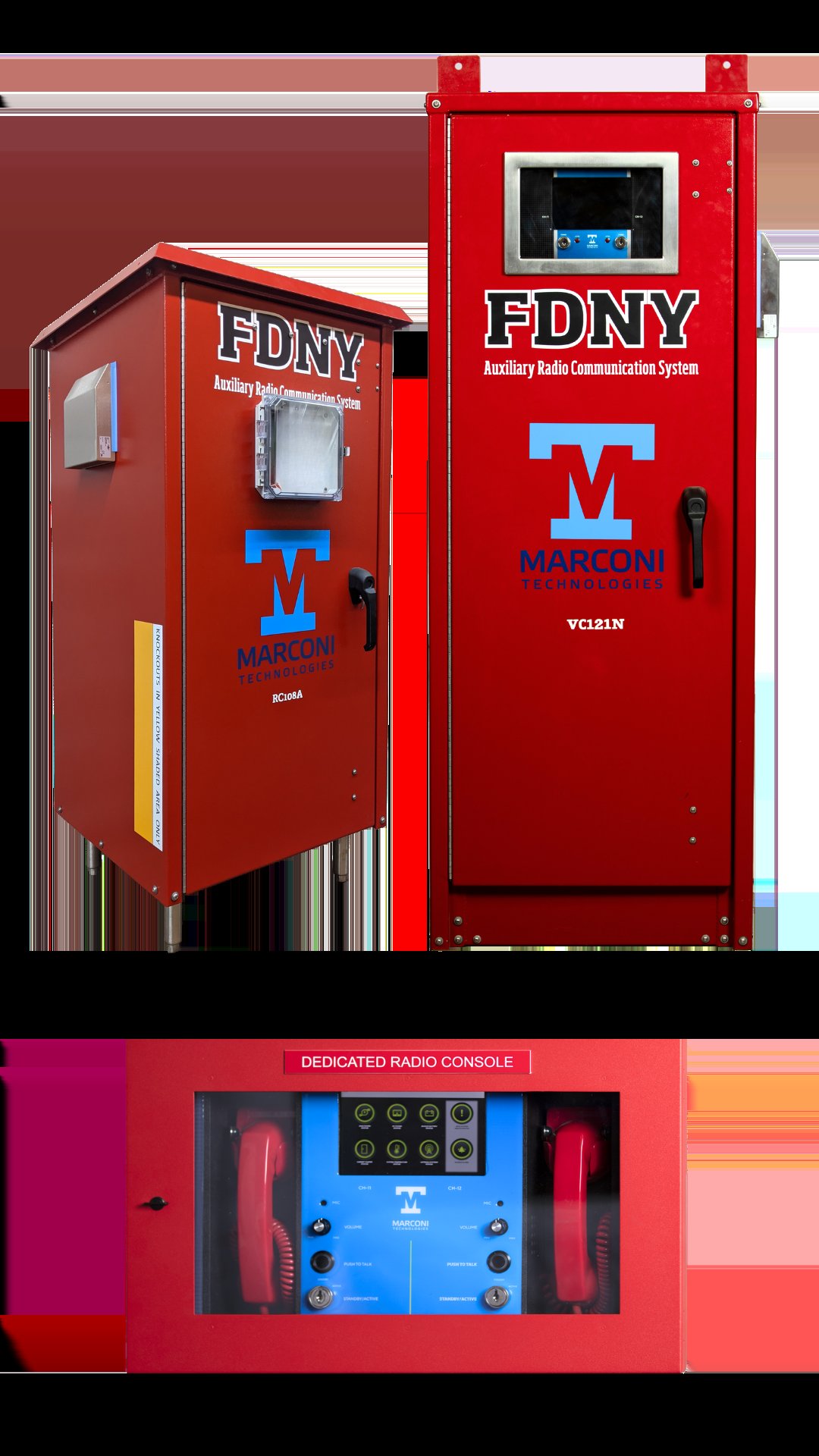
ARCS / FDNY
Auxiliary Radio Communication Systems for FDNY. Installed in NYC buildings over 75 feet per building code. Radio amplification, antenna distribution, backup power, active monitoring — the system firefighters depend on inside high-rise fires.
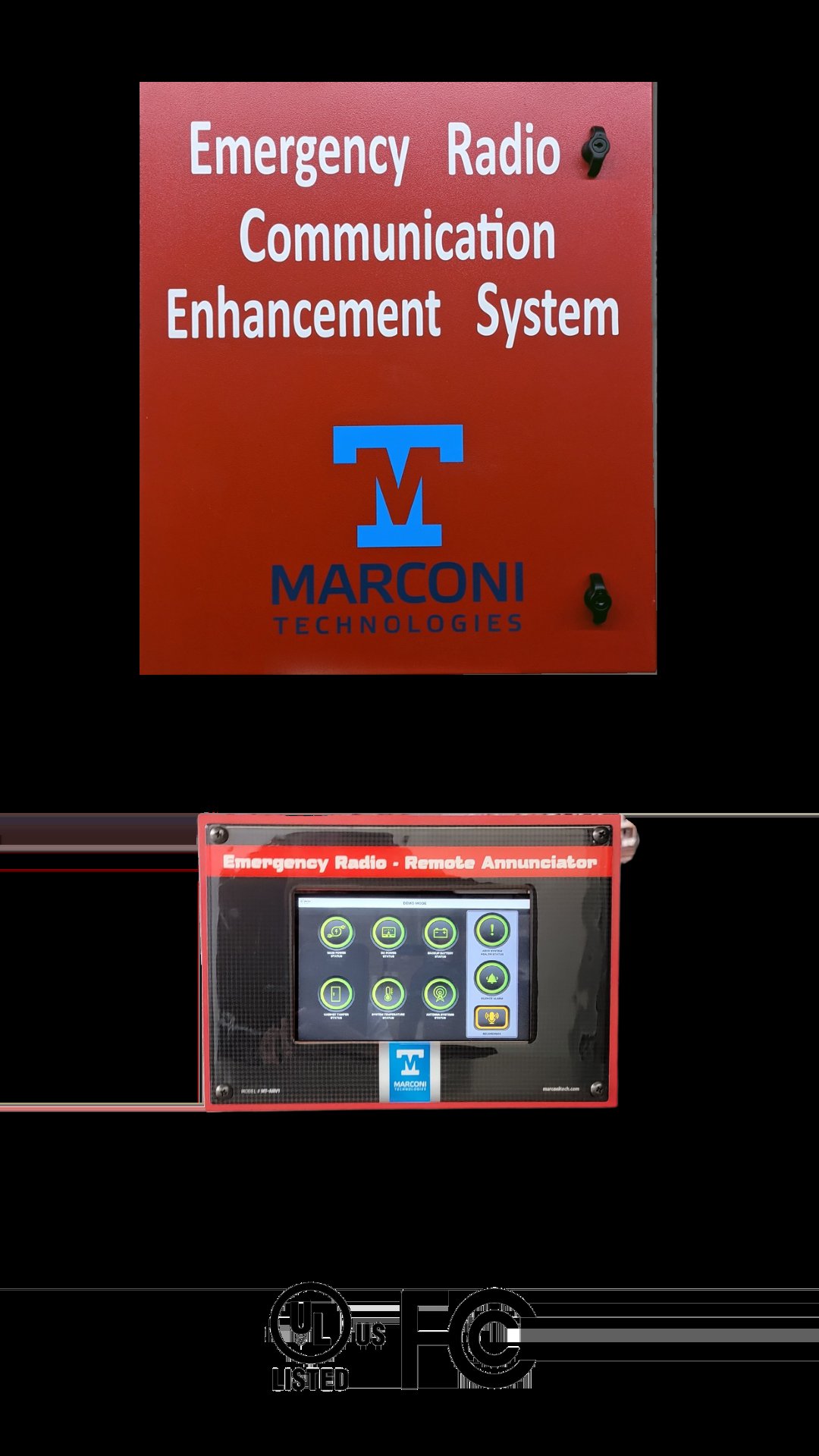
BDA / ERECS / DAS
Bi-Directional Amplifiers and Emergency Radio Enhancement systems for public safety. In-building coverage for emergency responders operating on UHF, VHF, 700MHz, and 800MHz bands. Modular, upgradeable, redundant.
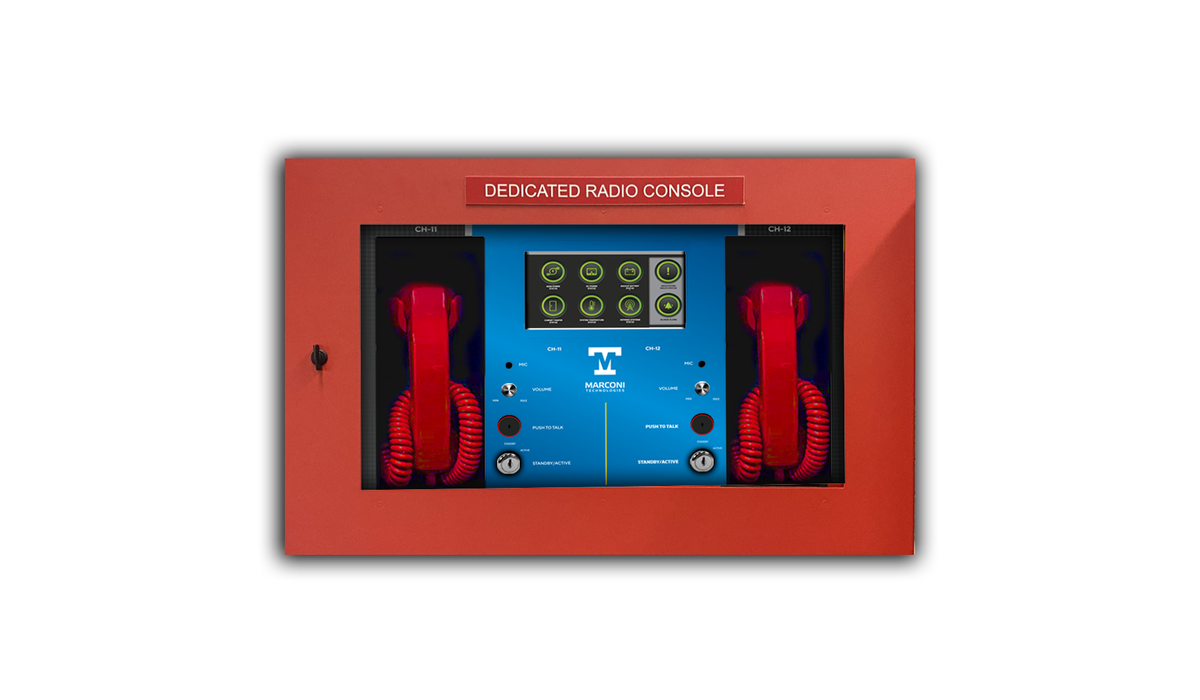
DRC — Radio Console
Dedicated Radio Console with 7” touchscreen for fire command center operations. Building management integration, alarm indicators, field-configurable interface. The lobby-side brain of the ARCS system.
What I’m building
I’m working with Marconi across multiple product development programs. Some are extensions of their existing platform. Others are entirely new product categories that expand what a life-safety communications company can offer to building operators and municipal authorities.
What I can say:
Power Platform
A new generation of uninterruptible power systems purpose-built for life-safety applications. Modular power architecture that scales across ratings. Modern battery chemistry support — LFP and NMC with cell-level BMS. Failover performance that exceeds IEC 62040-3 Class 1 requirements. These UPS systems don’t just keep the lights on — they keep emergency radio systems alive when the building’s main power doesn’t.
Embedded Systems
New embedded platforms spanning multiple product lines. Dual-processor architectures that separate safety-critical functions from application logic. Real-time control where physics demands it, flexibility where operations benefit. Unified firmware across product variants from a single codebase with hardware abstraction.
Communications
Expanding beyond traditional radio amplification into modern connectivity infrastructure. LTE integration, IP-based monitoring, remote diagnostics. Systems that report their own health, flag degradation before failure, and connect building safety infrastructure to the networks that modern emergency operations expect.
New Product Lines
Several products in development that extend Marconi’s capabilities into adjacent life-safety domains. I can’t discuss specifics yet. What I can say: these are category-expanding products, not incremental updates — new hardware platforms addressing unmet needs in critical building infrastructure.
The engineering underneath
A few things that define the quality bar when everything you build is life-safety rated:
Failure is not an option. Literally. Every system I design for Marconi operates under the assumption that someday, the building will be on fire, the power will be out, and a firefighter’s life will depend on this equipment working. That assumption drives every architecture decision, every component selection, every firmware state machine. There is no “graceful degradation” in a fire. There is working or not working.
Certification-driven design. UL listing isn’t something you bolt on at the end. The certification requirements — UL 2524 for emergency communications, UL 1778 for UPS systems, NFPA 72 for fire alarm — shape the architecture from day one. Component selection, PCB layout, thermal management, safety interlocks, test procedures — all designed around what the certification lab needs to see, not retrofitted after the first fail.
Power electronics for zero-downtime. The UPS platform uses dual-conversion online topology with PFC front-end. Modular 2.5kVA power stages that parallel for higher ratings without separate PCB designs per variant. Sub-4ms transfer time. The thermal path is designed for continuous duty in electrical closets with no forced ventilation — because NEMA 4x cabinets in building basements don’t have fans, and the system runs for years between service visits.
BMS that actually predicts. Cell-level voltage and temperature monitoring. Coulomb counting plus impedance-based SOC estimation across the full operating temperature range. SOH tracking that catches capacity fade and internal resistance drift before backup time drops below the rated minimum. In a life-safety UPS, a dead battery doesn’t mean “plug in the charger” — it means the building is non-compliant and the fire department may shut down occupancy.
Single-codebase firmware. Layered architecture with hardware abstraction at the base, real-time control loops running at 20kHz for power conversion, and an application layer for UI, communications, and diagnostics. One codebase, compile-time configuration per variant. This is how you ship multiple power ratings and product configurations without maintaining parallel firmware forks that drift apart.
What I can’t show yet
Several of the products I’m developing with Marconi are pre-release. They address real gaps in how critical building infrastructure is monitored, powered, and connected — particularly in high-density urban environments where building codes are evolving faster than the available technology.
When these products launch, they’ll be on this page. For now: active development, multiple product lines, new capabilities that expand what Marconi can offer to building operators, fire departments, and code authorities across New York City and beyond.
The environment
This is New York City life-safety infrastructure. The compliance landscape alone would stop most product companies:
Every product I build has to pass through this stack of certifications. And then it has to work — in a basement electrical closet, for years, with no maintenance, until the day someone’s life depends on it.
What this demonstrates
Life-safety product engineering is a different discipline. The failure modes are not “user sees an error message.” The failure modes are “firefighter can’t communicate during a high-rise fire” and “building loses emergency power during an evacuation.”
I work with Marconi because this kind of engineering is what I do — power electronics, embedded systems, certification-driven design, mission-critical reliability. Products where the engineering quality is invisible until the moment it matters most.
Read more about the work behind this
Building products for life-safety, critical infrastructure, or environments where failure isn’t acceptable?
I’m doing it now — UL-listed power systems, embedded platforms, certification-driven hardware for NYC’s most demanding safety requirements.
Start a conversation