
How I take products
from zero to production.
Built from years of shipping real hardware — and the failures that showed me exactly what breaks, and when. Three phases. Clear deliverables. You own everything.
Each phase is a standalone engagement with a fixed scope and deliverable. You decide whether to proceed at every stage.
Most hardware projects fail before they ship
Hardware product development is expensive. The cost of a wrong decision compounds — a bad architecture choice at month two becomes a six-figure rework at month eight. A component selected from a datasheet becomes a supply chain crisis when the lead time turns out to be 40 weeks.
Most hardware failures are not engineering failures. They are decision failures: building before understanding, optimizing before validating, scaling before the design is ready. This framework makes sure the expensive decisions get made correctly — and early.
at week 2
at month 4
at month 8
The cost of the same decision grows exponentially the later you make it. This framework front-loads the decisions that matter.
Definition & Feasibility
I define the product architecture, map the technical risks, and create a validated plan for everything that follows — before any expensive engineering begins.
What happens in this phase:
- Requirements definition — translating business requirements and user needs into focused, actionable engineering specifications the team can build against.
- Architecture definition — system-level design covering mechanical, electrical, firmware, and software subsystems. How do they interact? Where are the interfaces? What are the dependencies?
- Risk mapping — identifying specific, testable technical unknowns that could derail the project. Not theoretical risks — questions that need answers before committing to execution.
- Component research — critical component selection with supply chain reality checks. Availability, lead times, alternate sources, and cost at target volumes.
- Phase planning — defining what gets built next, in what order, and why. Each subsequent phase has a clear scope, deliverable, and validation criteria.
What you get:
A system architecture document, risk register, preliminary BOM with cost model, and a phased execution plan.
This is a standalone deliverable — you own it regardless of whether you continue with me.
The most expensive prototype is the one
that validates the wrong assumption.
Prototype & Validation
Prototyping is not about building a demo. It's about answering the questions identified in Phase 1 — with hardware, with data, with evidence. Every prototype I build has a specific validation objective.
What happens in this phase:
- Targeted prototyping — building the minimum hardware necessary to validate the highest-risk elements. Sometimes that's a full functional prototype; sometimes it's a focused test rig for one specific subsystem.
- Validation testing — structured tests against the criteria defined in Phase 1. Thermal, mechanical, electrical, environmental — whatever the risk map identified as critical.
- Iteration — most first prototypes fail to meet spec in at least one area. That's by design. Validation failure is data, not setback — it updates the architecture and informs Phase 3 scope.
- Architecture refinement — updating the system design based on what the prototype actually taught me. Real test data replaces assumptions.
- DFM assessment — evaluating the prototype design against manufacturing constraints. Can this be injection molded? What tolerances are achievable? What does the assembly sequence look like?
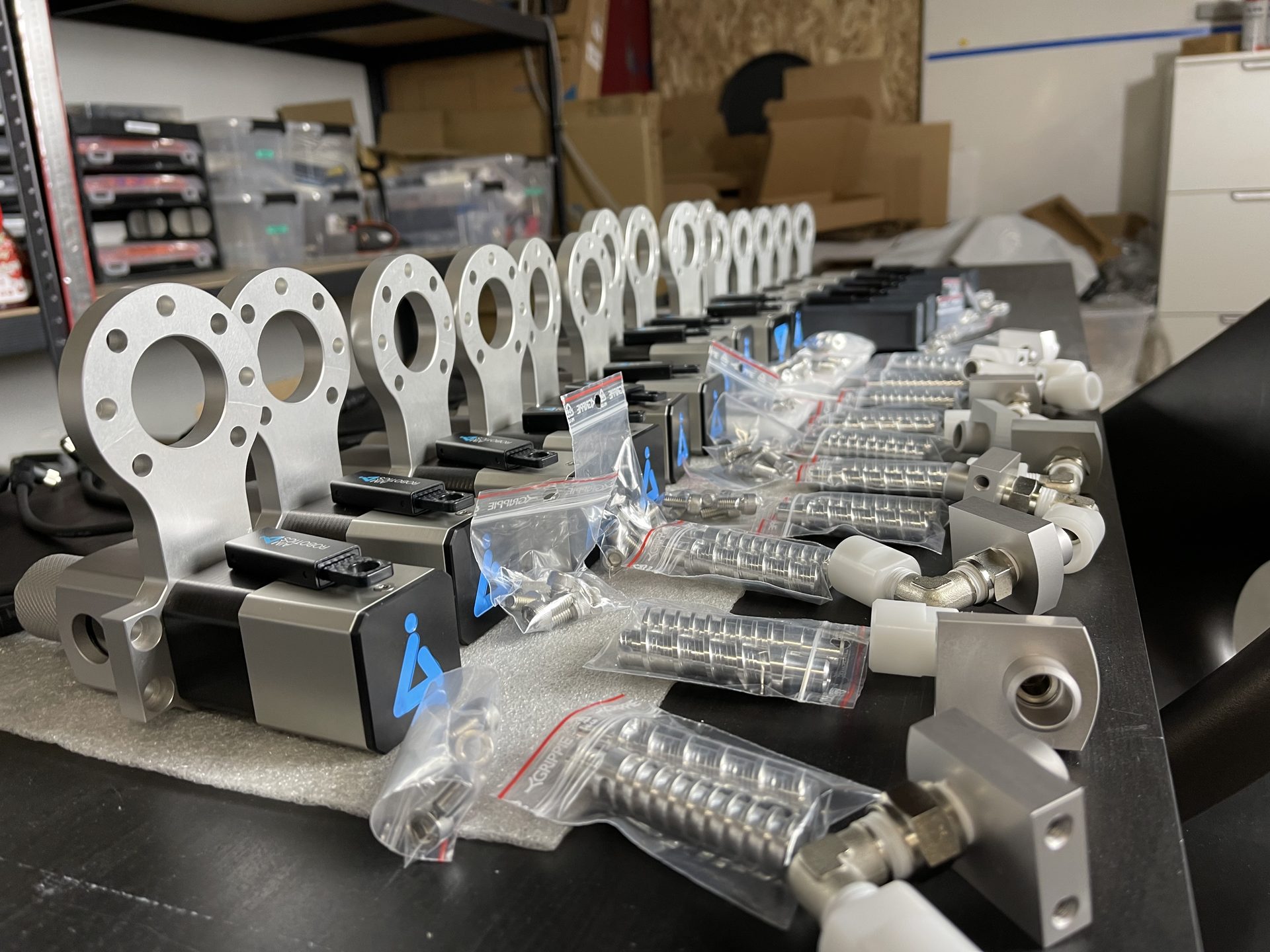 Production-intent prototypes on the assembly bench — AimRobotics dispensing units going through validation.
 What you get:
A functional prototype with documented test results, an updated architecture specification reflecting validated design decisions, and a production readiness gap analysis showing exactly what needs to change before manufacturing.
The gap between "working prototype" and
"shippable product" kills more hardware startups
than bad ideas ever will.
Production Readiness
This phase bridges the gap between validated prototype and volume manufacturing — resolving every issue that stands between your design and a product that can be built repeatably, at quality, at scale.
Design for manufacturing:
- DFM finalization — resolving every manufacturing concern: draft angles, wall thicknesses, tolerance stacks, material selections, and assembly sequence optimization.
- Production documentation — manufacturing drawings, assembly instructions, test procedures, and quality criteria. Everything a contract manufacturer needs to build your product independently.
- Test infrastructure — designing and building production test fixtures and writing test firmware. Every unit that leaves the factory gets tested against defined pass/fail criteria.
Supply chain & compliance:
- Supplier qualification — finalizing component suppliers, negotiating pricing, and establishing backup sources for critical components.
- Certification preparation — pre-compliance testing and documentation for required certifications (CE, FCC, UL, etc.). I identify certification risks early and design for compliance, not after-the-fact.
- Pilot production — supporting the first production run to validate the manufacturing process, identify yield issues, and confirm that the product meets specification at volume.
What you get:
A production-ready product package: final design files, manufacturing documentation, test infrastructure, qualified suppliers, and a validated manufacturing process. You are ready to manufacture.
After Phase 3
You have everything you need to manufacture independently — design files, documentation, test infrastructure, qualified suppliers. Some clients take the package to their own CM and scale from there. Others ask me to support production ramp, manage the CM relationship, or continue with ongoing product engineering.
Either way, there is no lock-in. You own the IP, the files, and the relationships. I build it so you can run it without me.
How I operate differently.
You decide at every stage
Clear deliverables at the end of each phase mean you have full visibility before committing to the next one. No open-ended engagements.
Hardware answers, not theoretical analysis
In hardware, the wrong assumption at the architecture stage costs months and six figures. I build minimum testable hardware to get answers before committing to design decisions.
Manufacturing is a first-class constraint
I design for production from Phase 1. Not as an afterthought. Not as a DFM review tacked on at the end. It's embedded in every decision.
You own everything I produce
Every deliverable — architecture documents, design files, firmware, test procedures — belongs to you. No IP lock-in, no proprietary formats, no dependency on me.
Is this framework right for your project?
Good fit
- Technically difficult hardware or hardware+software product
- Serious about shipping — not just exploring
- Budget appropriate for senior-level engineering
- Need architecture clarity before committing to execution
- Existing prototype that needs to be production-ready
Not a fit
- Simple enclosure + off-the-shelf electronics
- Software-only product
- Looking for the cheapest option
- Need a large team of junior engineers
- Want hourly billing with open-ended scope
Your next step is Phase 1.
Four to eight weeks to architecture clarity, risk mapping, and a plan you can build against. Tell me what you're building and I'll scope a Definition phase — fixed price, clear deliverable, no commitment beyond that.
Start With Definition