
AimRobotics
Built an entire product company from scratch — custom motors, custom coils, custom PCBAs, patented dispensing mechanisms, EMC-certified, deployed at Lockheed Martin, Aston Martin, BMW. CTO role from day one.
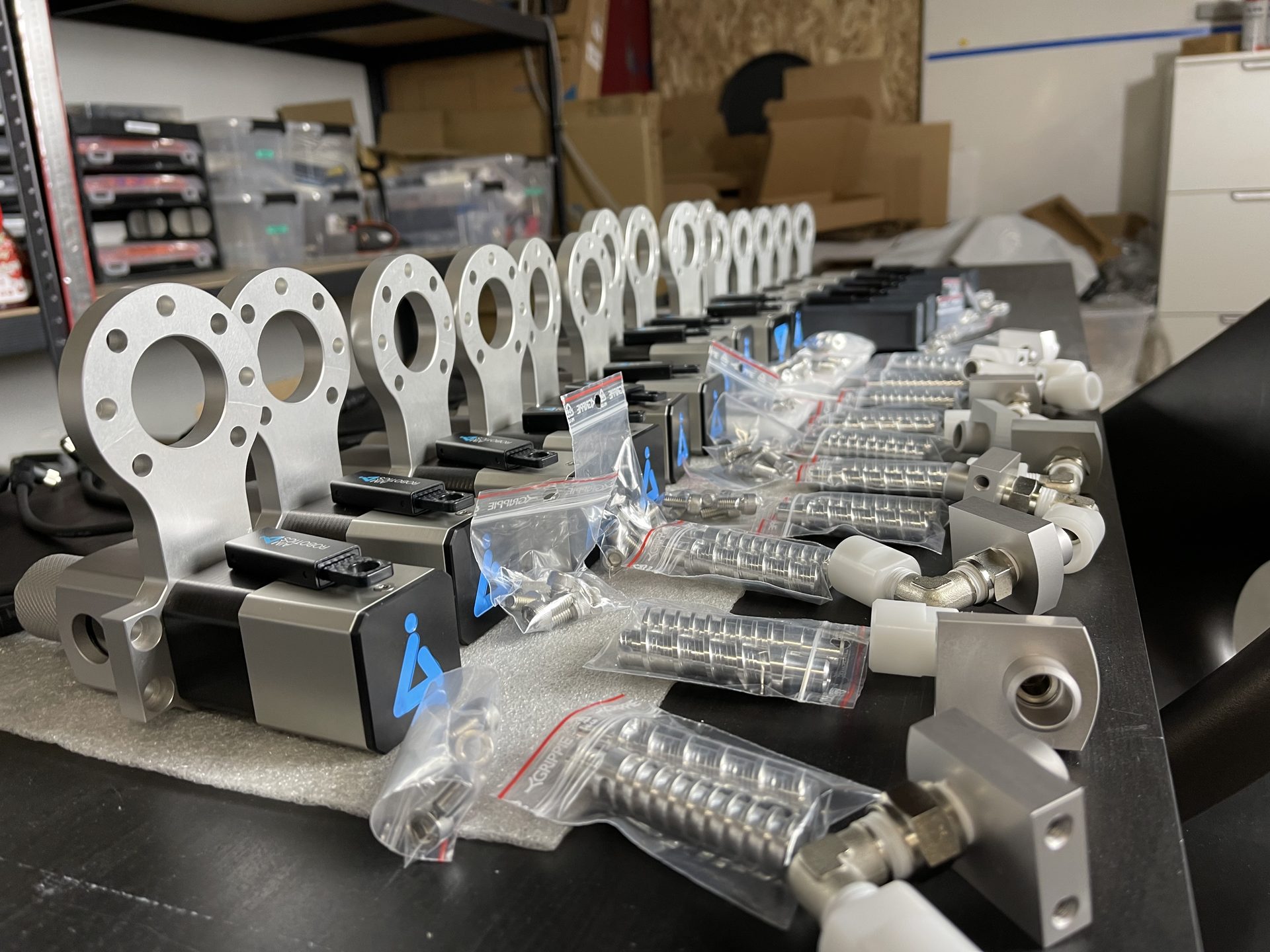
Context
AimRobotics makes precision robotic dispensing tools for collaborative robots. The products are deployed on factory floors at Lockheed Martin, Aston Martin, BMW, and tier-1 electronics manufacturers across 30+ countries through a network of 50+ distributors.
Every product in the current lineup was designed, engineered, prototyped, tested, certified, and brought to production under my technical leadership. CTO role from the first sketch to the current shipping product line.
This was not a consulting engagement. This was building a product company.
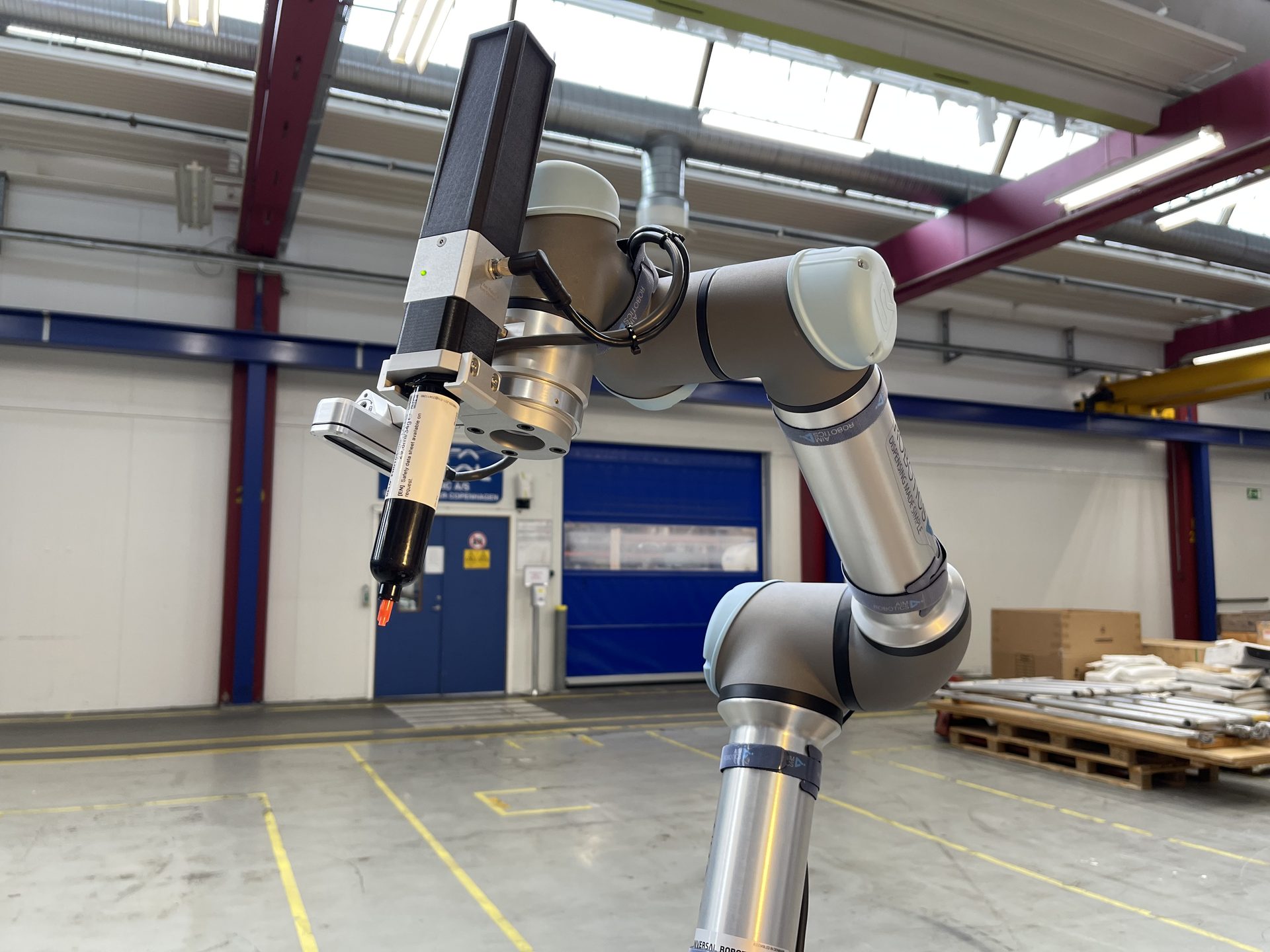 AimRobotics dispenser deployed on a UR cobot — industrial facility, Copenhagen.
Starting from zero
There was no product. No architecture. No team. No supply chain. No certification. No customers.
The founding thesis was simple: pneumatic dispensing on cobots is imprecise, hard to set up, and impossible to reproduce reliably. The incumbent solutions were either over-engineered industrial systems that cost more than the robots themselves, or cheap pneumatic valves that couldn’t hold a tolerance.
The question was whether you could build an electronically controlled dispensing system — purpose-designed for collaborative robots — that could beat pneumatic precision at a price point that made sense for cobot integrators.
The answer required custom everything.
Why custom everything
Off-the-shelf motors couldn’t meet the torque-to-size ratio needed to fit inside a cobot-mountable form factor while delivering the force required to push high-viscosity fluids through a precision nozzle. Off-the-shelf coils couldn’t hit the inductance profile needed for the control loop bandwidth. Off-the-shelf PCBAs didn’t exist for this application — the control electronics needed to handle motor commutation, sensor feedback, fluid pressure regulation, serial communications with the robot, and safety monitoring, all on a board small enough to fit inside the tool housing.
So I designed it all from scratch.
Custom motors. Purpose-wound for the specific torque curve and speed profile each dispenser requires. The SD series uses a linear motion system with a motor designed for microliter-range positioning accuracy. The FD series uses a different motor architecture optimized for sustained high-force cartridge compression across viscosity ranges from 20,000 to 500,000+ cP.
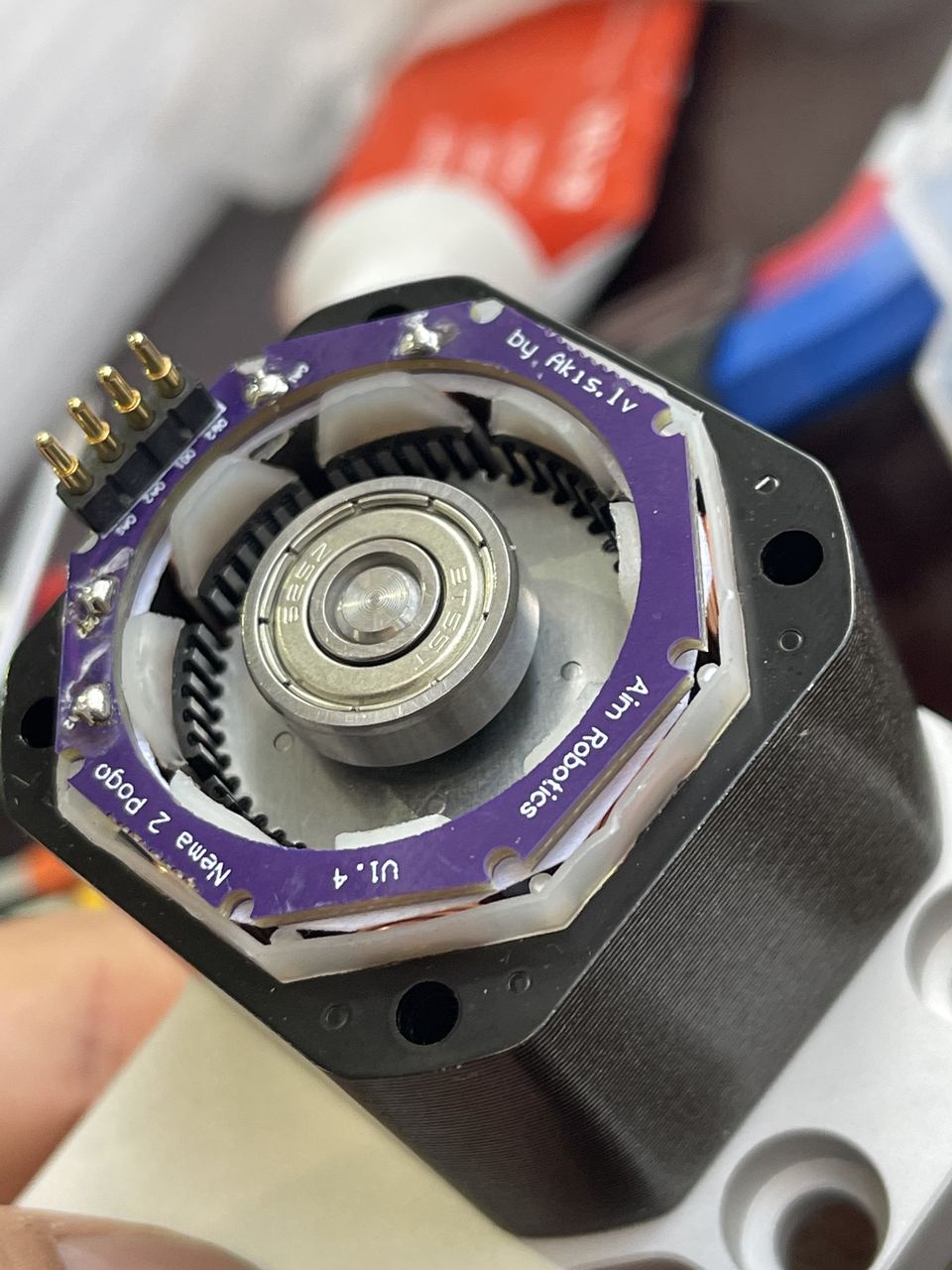 Custom motor assembly — planetary gearbox, purpose-wound coils, pogo-pin encoder interface. The purple PCB reads “Aim Robotics” and “by Akis.lv” — my engineering, their product.
Custom coils. Wound to specific inductance and resistance targets that match the motor driver’s switching frequency and the control loop’s bandwidth requirements. This is the kind of detail that separates a product that works on a bench from a product that works on a production line at 3 AM.
Custom PCBAs. Every board in the product line is a ground-up design. Motor drive, current sensing, temperature monitoring, pressure regulation, RS485 serial communication, safety interlocks — integrated onto compact PCBAs that fit inside tool housings designed for ISO 9409-1:2004 flange mounting. The AirBox controller adds precision pneumatic regulation with analog/digital IO, supporting six different effector configurations from a single control platform.
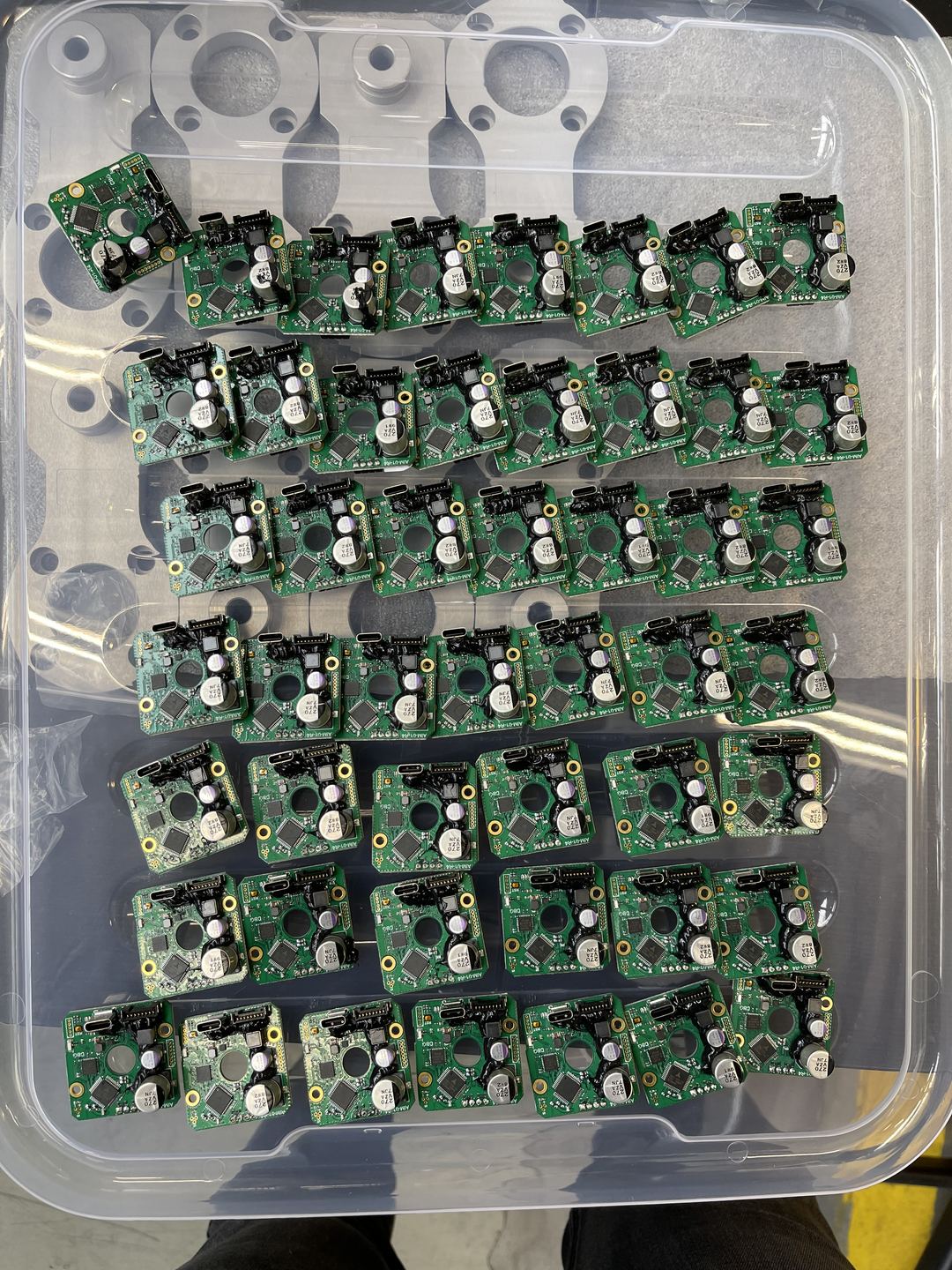 Production batch — custom PCBAs with motor drivers, power regulation, and RS485 comms. AIM-01-R4 revision.
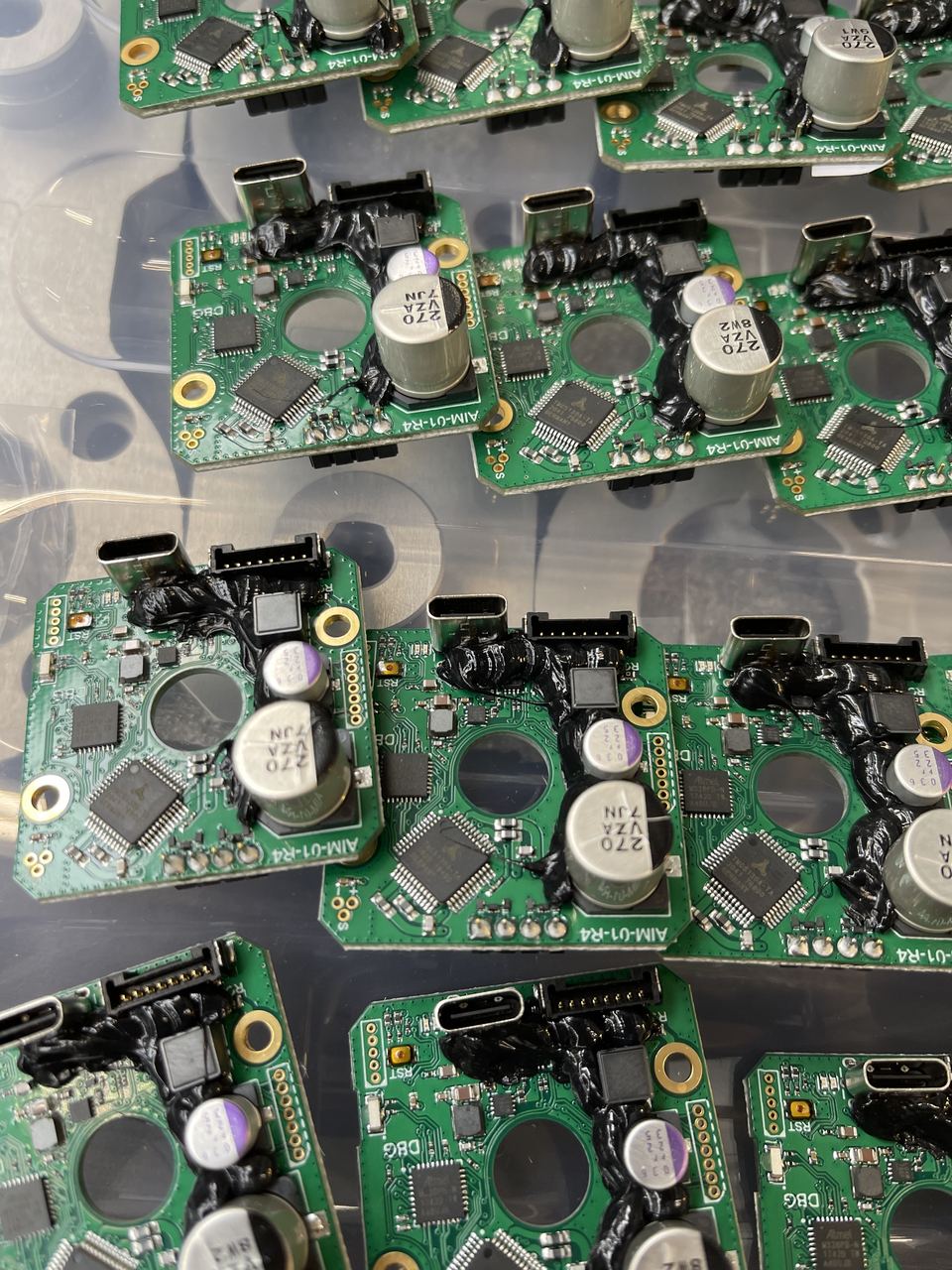 Board detail — USB-C programming interface, conformal coating on power section, 270μF bulk capacitors for motor drive current.
The product line
What shipped is not one product — it is a full product architecture covering the range of industrial dispensing applications on collaborative robots.
SD Series — Syringe Dispensers
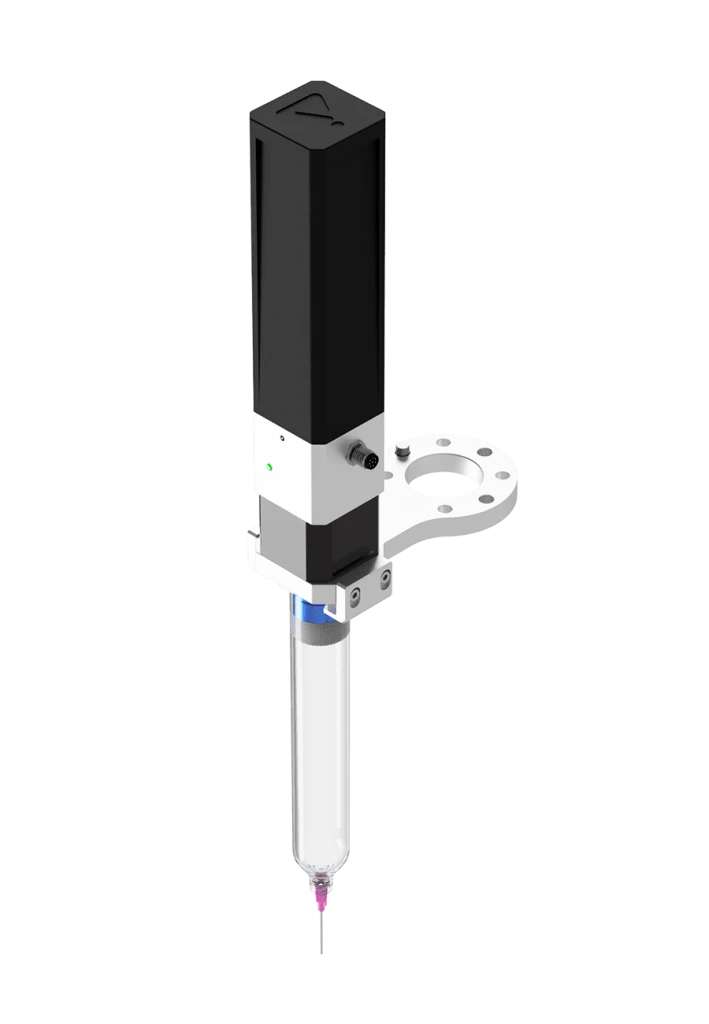
SD 30/55
Airless high-precision syringe dispenser
- Patent-pending linear motion system
- No compressed air required
- 30cc and 55cc standard syringes
- Microliter-range doses, sub-2mm bead widths
- Viscosity range: up to 20,000 cP
- Materials: adhesives, silicones, thermal compounds
The SD 30/55 is the precision instrument of the lineup. This is the product that goes into electronics manufacturing lines where you’re dispensing thermal interface material onto a component that costs more than the robot’s hourly rate.
The patent-pending linear motion mechanism is the core differentiator. It eliminates the pressure-volume nonlinearity that makes pneumatic dispensing inherently imprecise. The motor drives a precision lead screw that moves the syringe plunger at a controlled, measured rate. What comes out of the nozzle is a function of motor position, not air pressure — which means it’s repeatable, programmable, and independent of fluid viscosity drift and temperature change.
FD Series — Cartridge Dispensers
Three products, one modular platform. Interchangeable — operators can switch between FD configurations on the same robot without re-tooling.
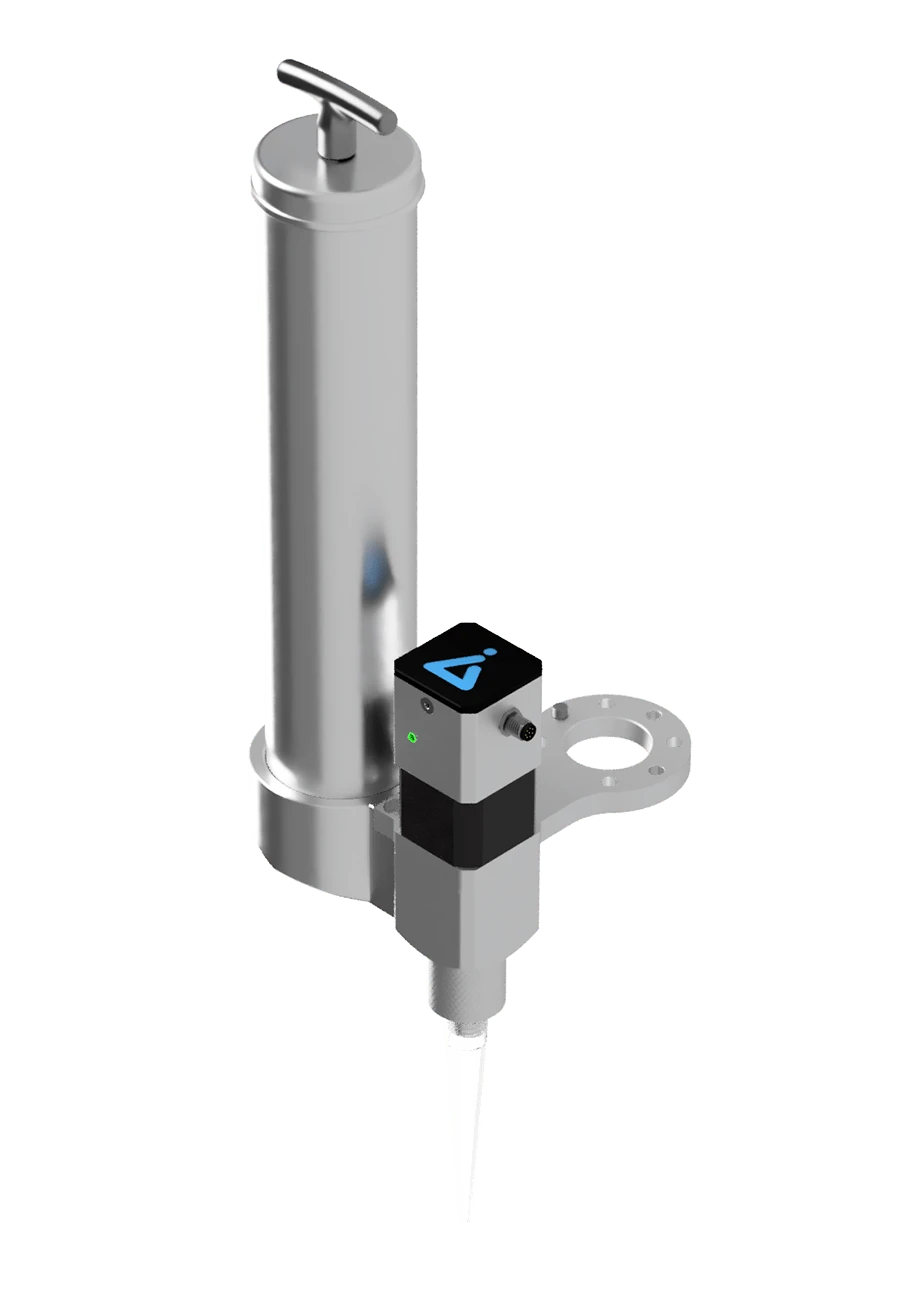 No. 9044
FD 400
The original. Fully airless, all-in-one. 400ml DIN 1284 cartridges. Auto dosing speed compensation as cartridge empties.
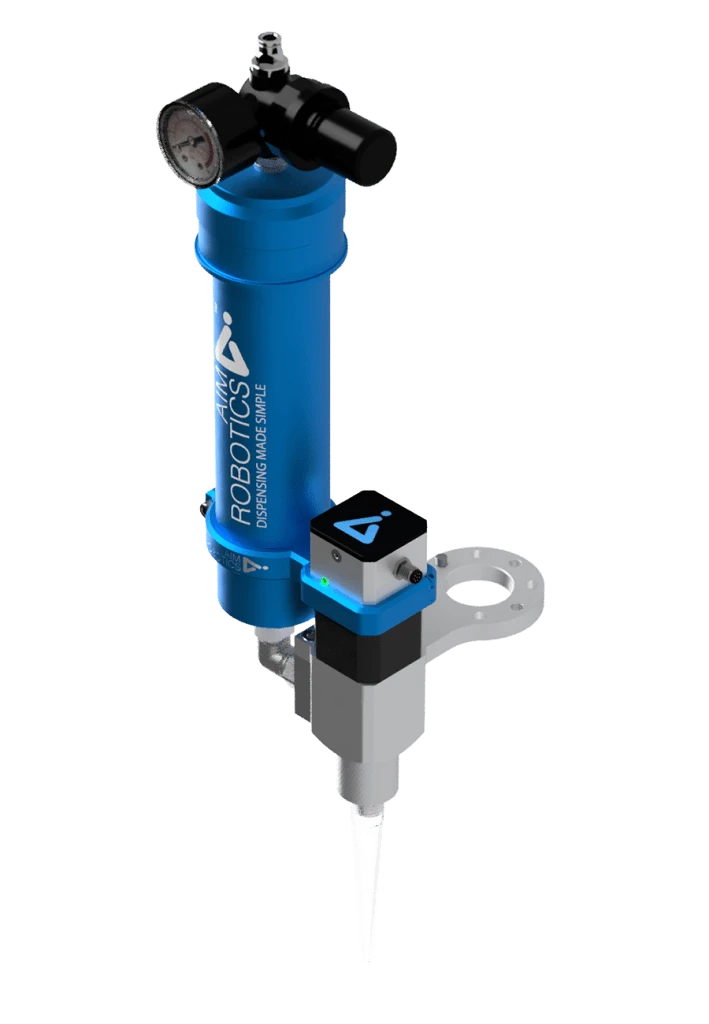 No. 9000
FD 310
Compressed air feed for 310ml cartridges. Air feeds the dosing pump without affecting dosing quality. Up to 3 bar supply.
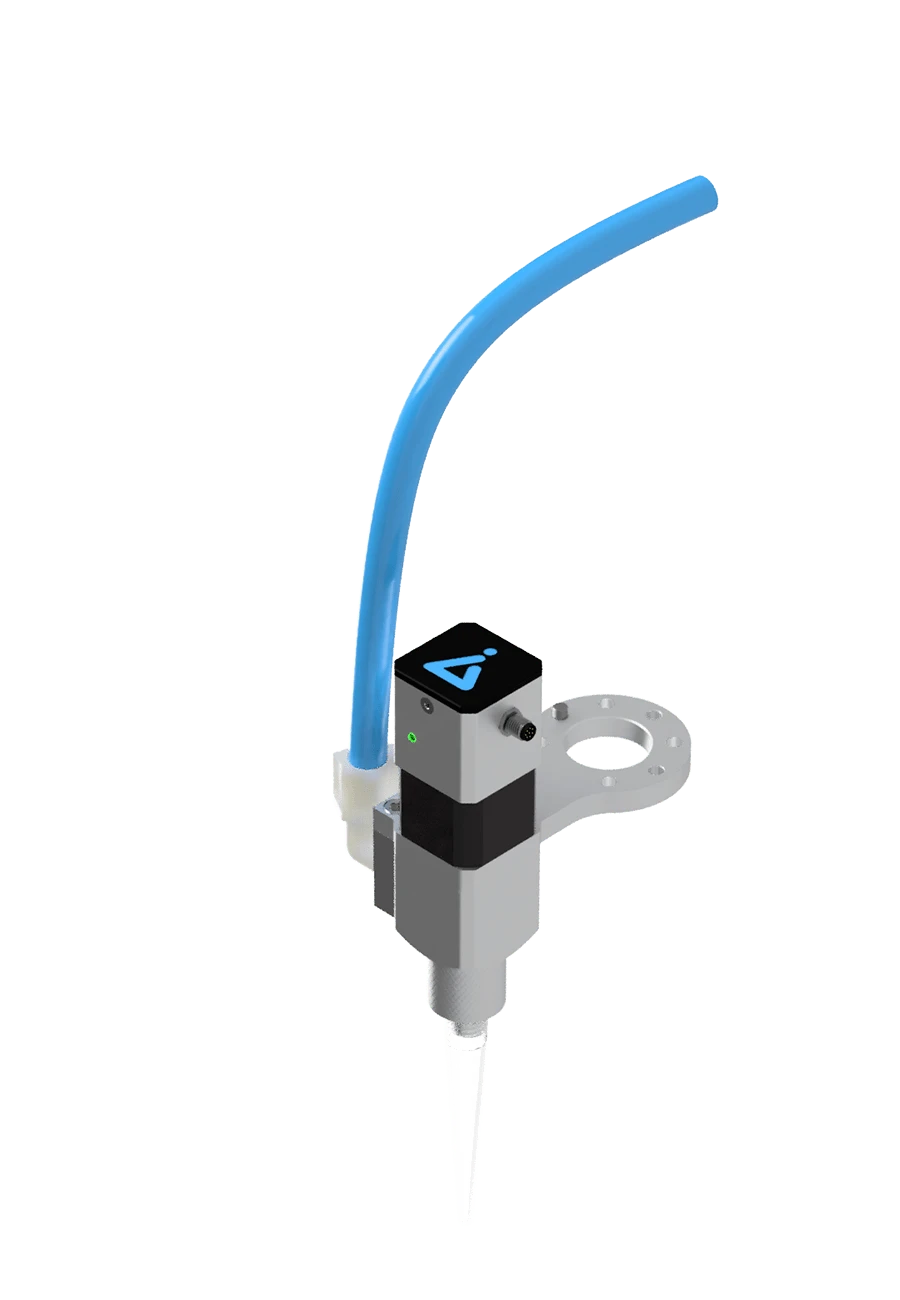 No. 9027
FD HighV
External feed for high-volume and long unattended intervals. Bulk supply instead of individual cartridges. Same precision pump.
All three share the same dosing pump architecture — a custom motor-driven positive displacement mechanism designed for medium viscosity materials in the 50,000–500,000 cP range. Adhesives, silicones, greases. The modularity is in the feed system, not the precision mechanism. That’s how you get three products from one engineering investment without compromising any of them.
AirBox — Electric Precision Controller
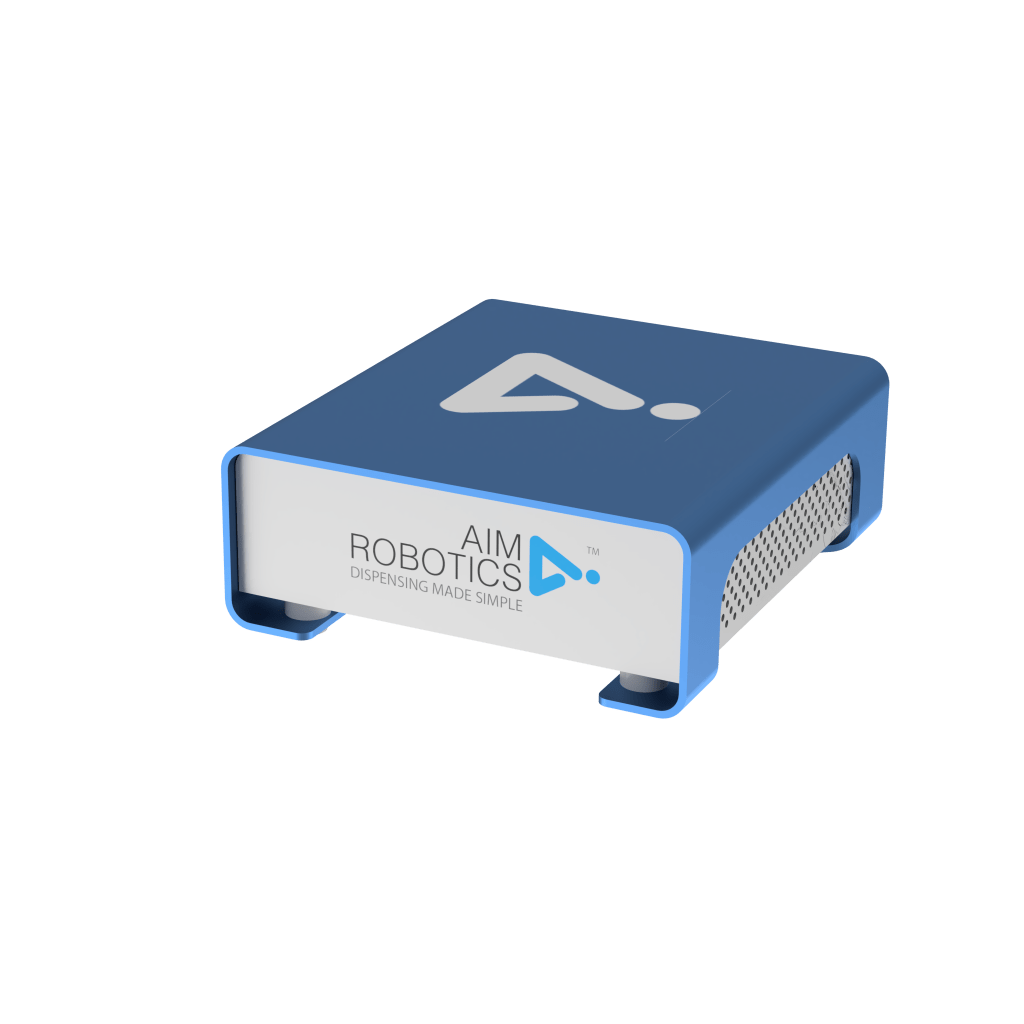
AirBox
Fully electric precision dispensing controller
- 6 swappable effector configurations
- 2K two-component epoxy dispensing
- Multiple mix ratios (1:1, 1:2, custom)
- Analog/digital IO interface
- Up to 7 bar compressed air
- ISO 9409-1:2004 flange mount
The AirBox is the platform product. One controller, six cartridge and syringe configurations through swappable effector modules:
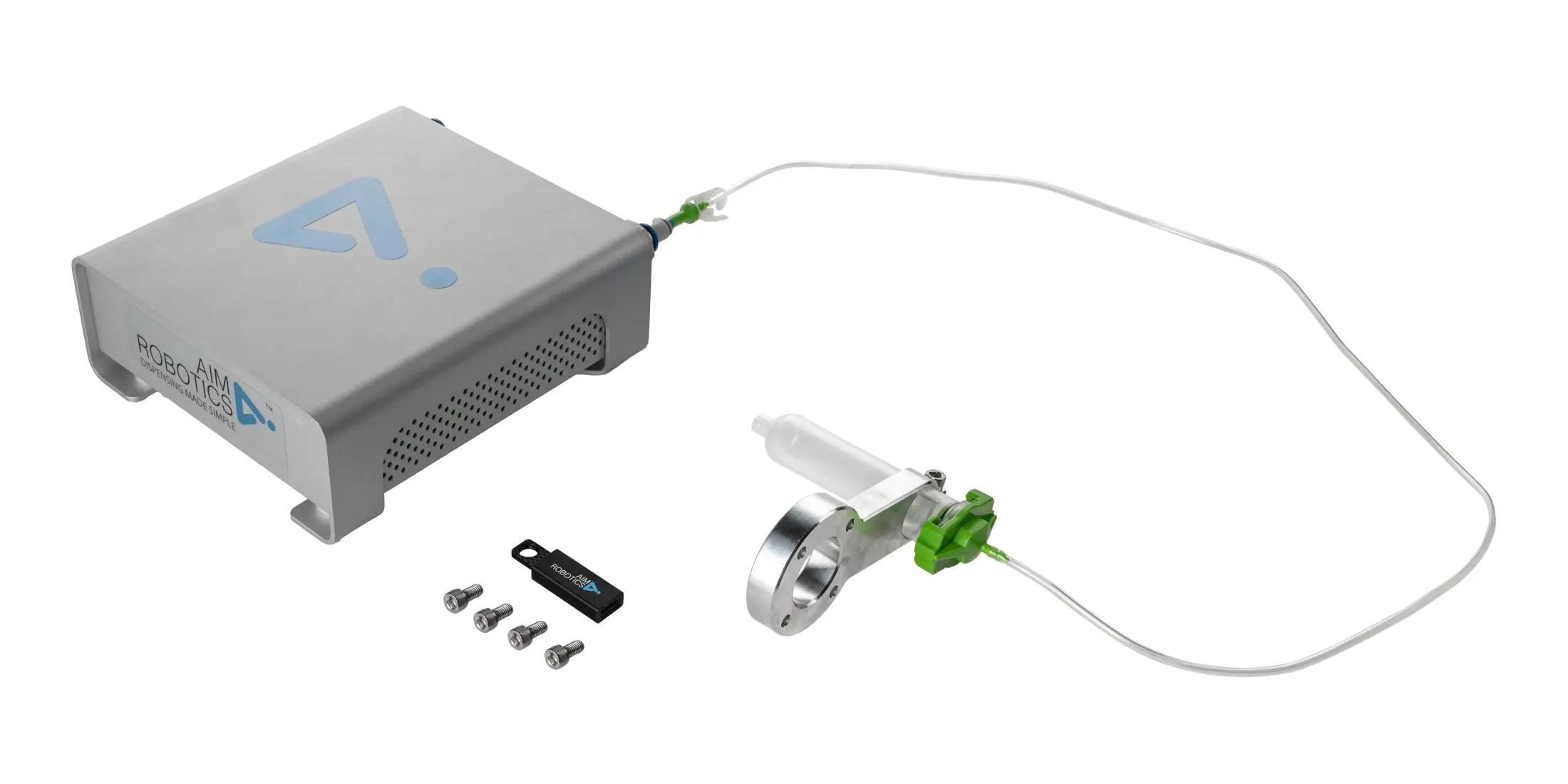
30/55cc Syringe
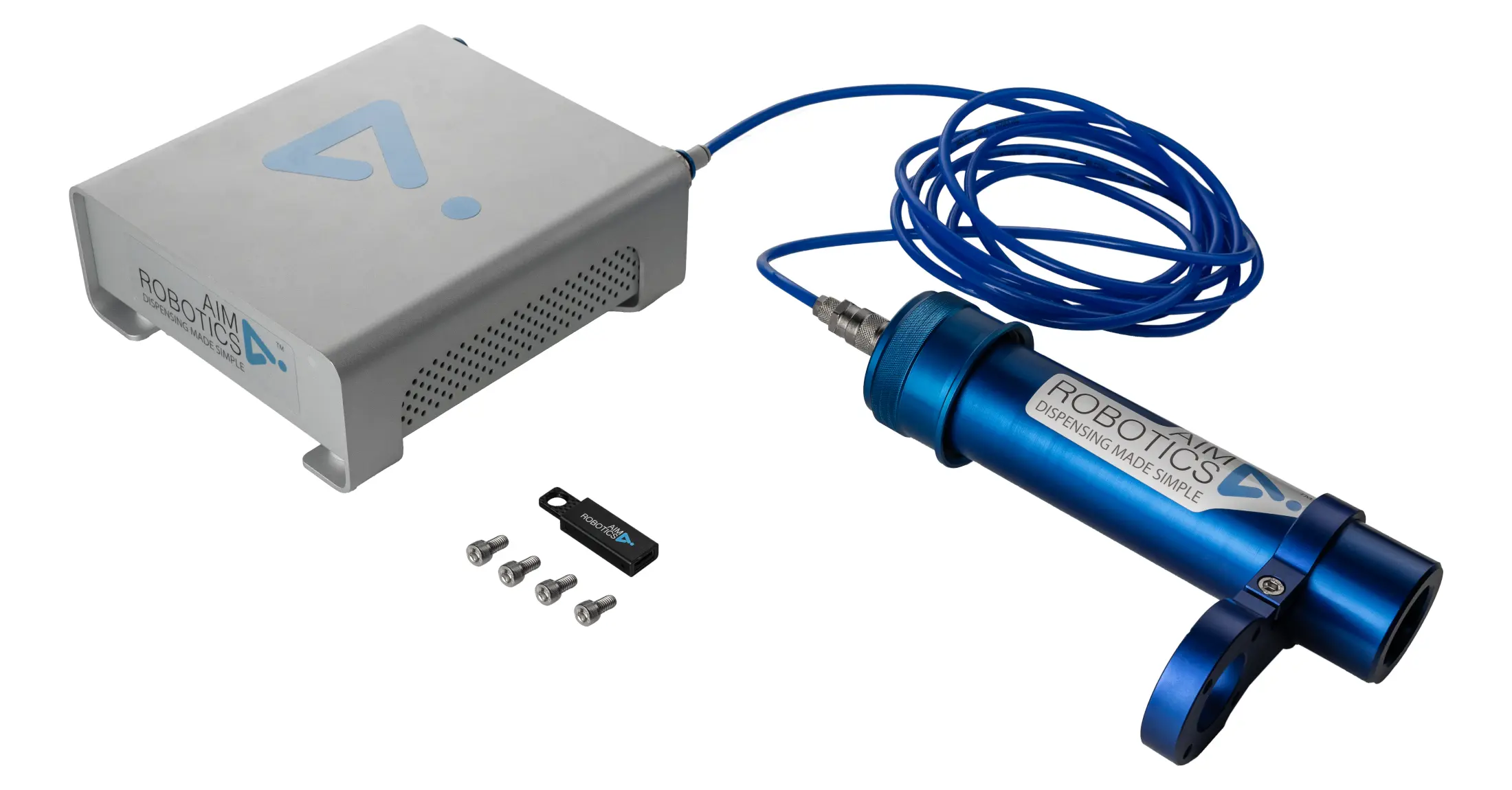
310cc Cartridge
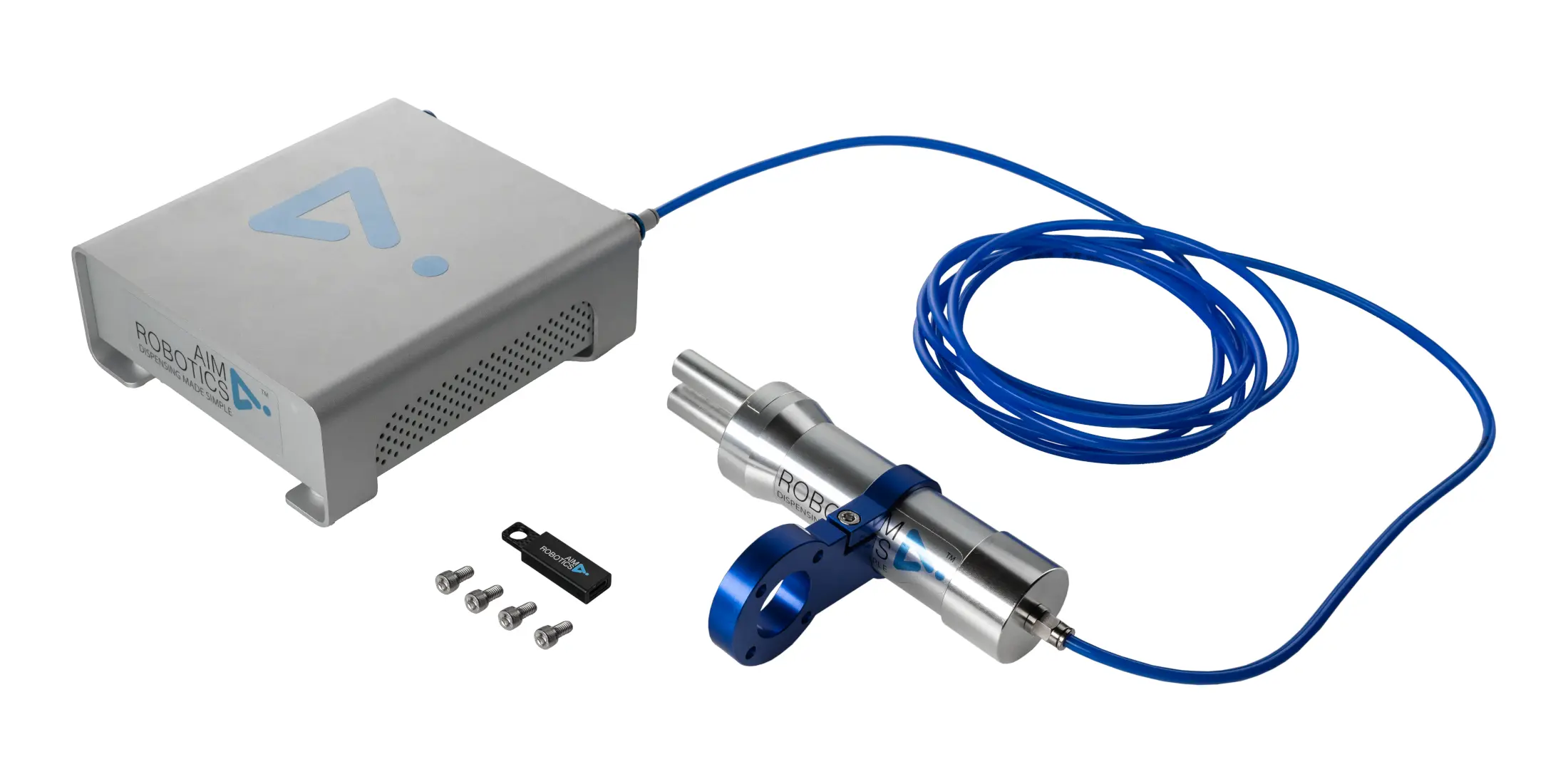
2K 50cc — 1:1
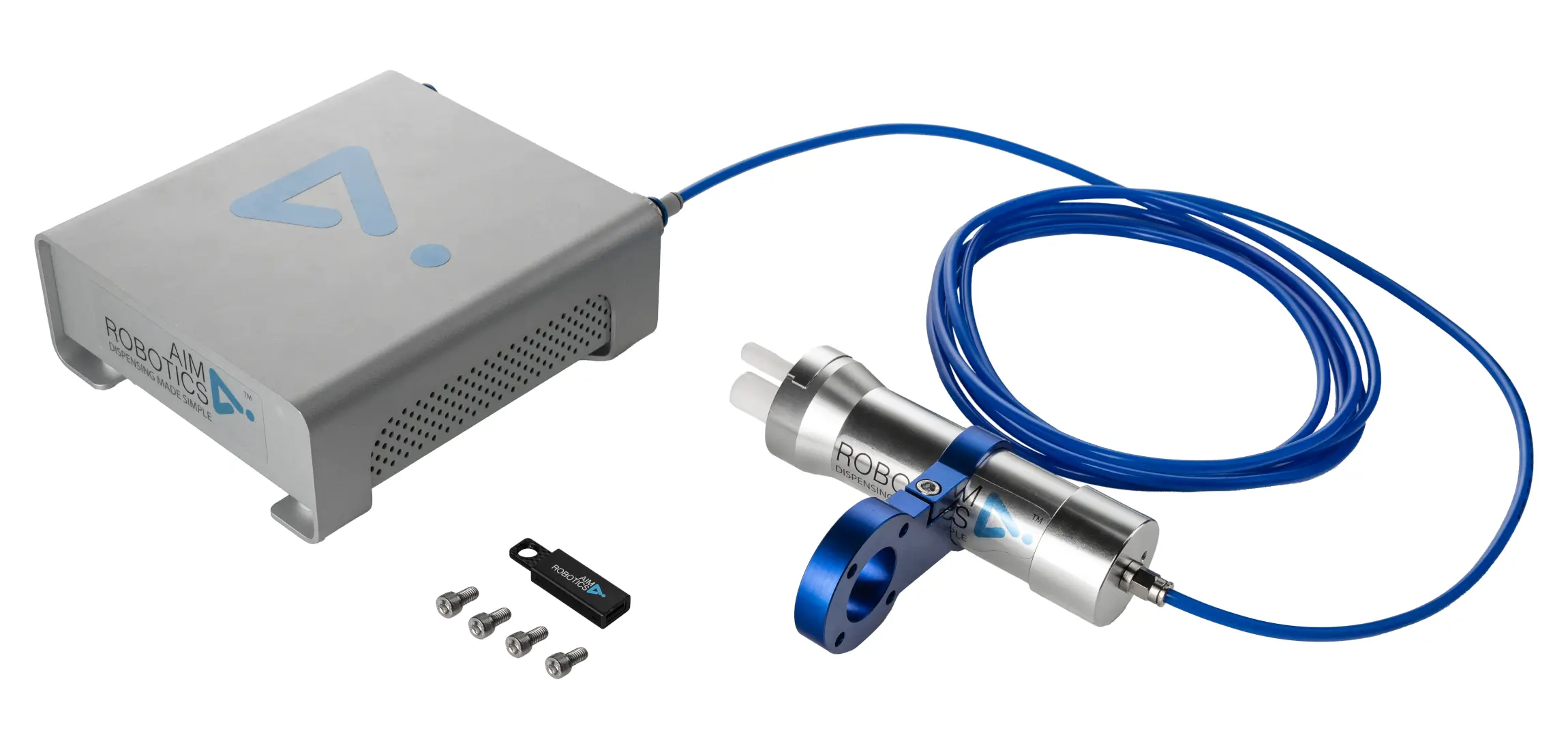
2K 50cc — 1:2
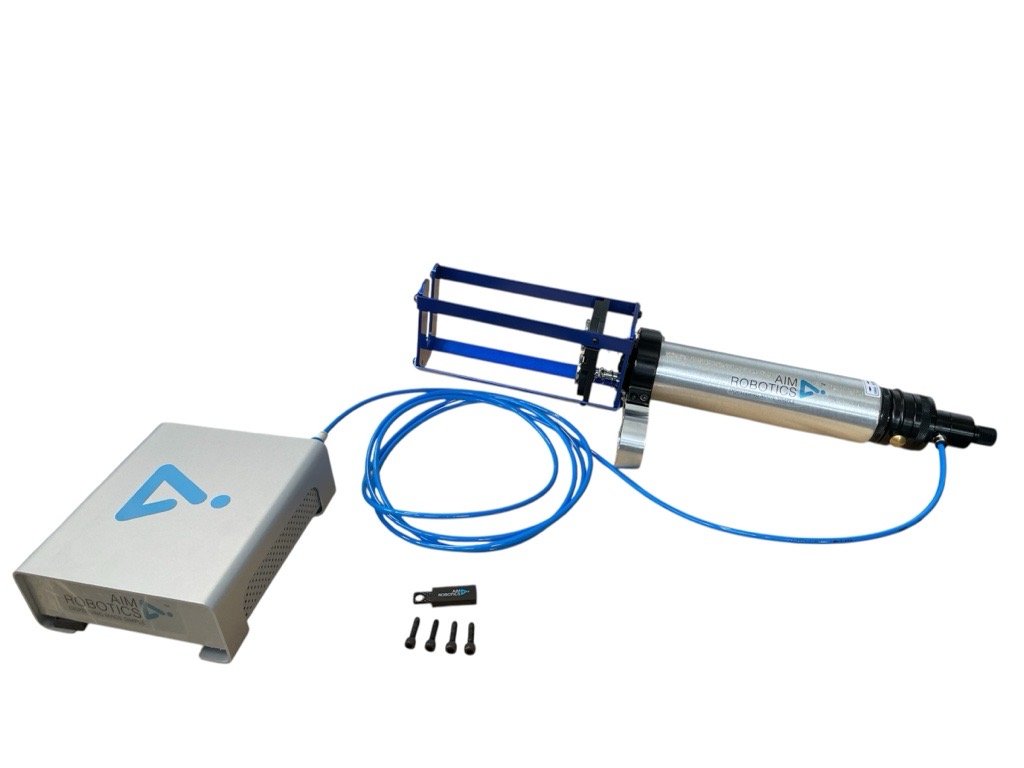
2K 400cc Multi-ratio
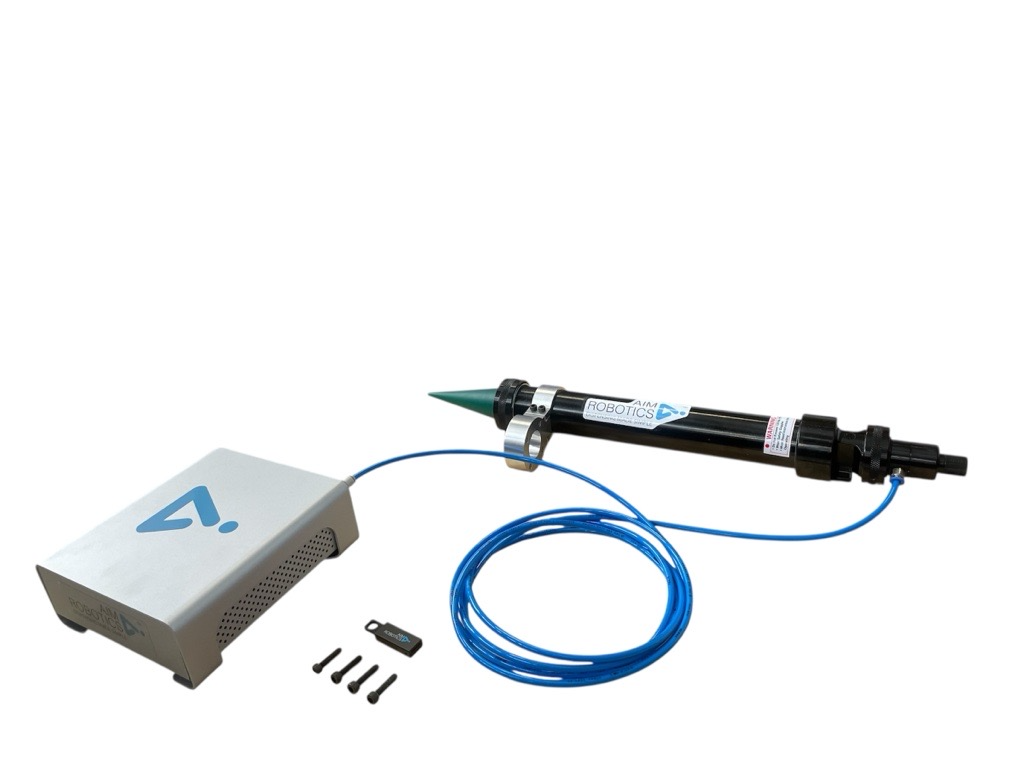
600cc Cartridge
The 2K configurations are particularly demanding — mixing two-component adhesives requires precise ratio control, synchronized feed rates, and static mixing that doesn’t introduce air. Get the ratio wrong and the adhesive doesn’t cure. Get the feed timing wrong and you get voids. The AirBox handles this electronically, not pneumatically.
Tools and Software
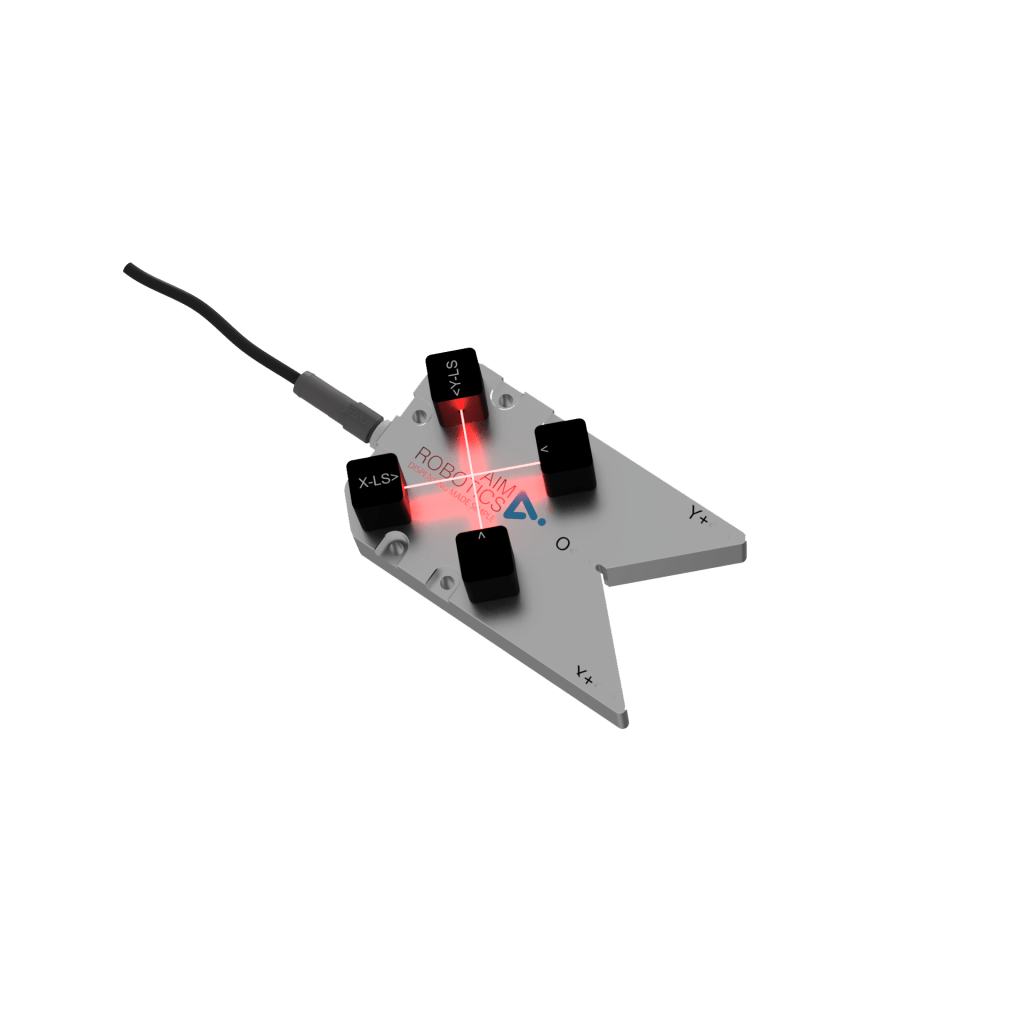 No. 9226
TCP Calibration Tool
High-precision LED-based tool center point calibration. Detects tips down to ø0.3mm diameter with ±0.02mm repeatability. Purpose-built optics and detection firmware.
Solves the problem of re-establishing TCP after tool changes or needle replacements — a calibration step that, done manually, introduces the positioning error that the dispenser was designed to eliminate.
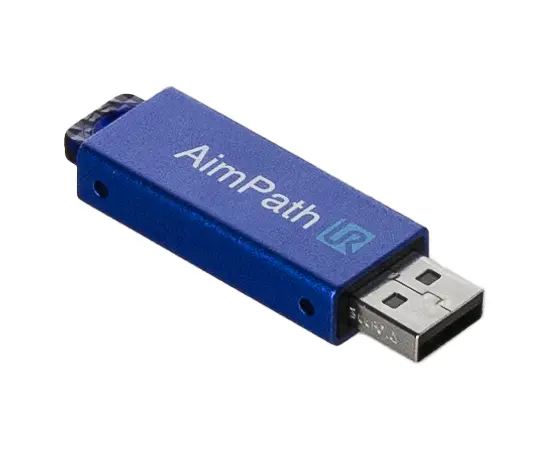 No. 9503
AimPath URCap
Path logging and playback software for Universal Robots. Records dispensing paths for replay, enabling operators to capture complex bead patterns by manual teaching and reproduce them with machine precision.
Robot compatibility
Every product supports Universal Robots natively through RS485 serial communication with dedicated URCap interfaces. The hardware interface is standardized: 24V/2A peak via M8 connector (Lumberg RKMV8 or equivalent), ISO 9409-1:2004 flange mounting.
Supporting eight robot manufacturers from a single hardware platform required careful abstraction in the firmware. The communication layer, dispensing control logic, and robot-specific protocol handlers are cleanly separated — which is how you ship one hardware product across an ecosystem without maintaining eight firmware forks.
Patents and certification
Patent applications filed in Europe and the United States covering the core dispensing mechanisms — specifically the linear motion system used in the SD series and the electronic dispensing control architecture.
Full EMC certification. The products operate on factory floors alongside welding equipment, motor drives, and RF noise sources that would destroy uncertified electronics. EMC compliance was not a formality — it required deliberate PCB layout, shielding, filtering, and grounding design from the first board revision. The custom motor drive circuits were particularly demanding: high-current switching at the commutation frequency generates broadband emissions that had to be suppressed without degrading motor performance.
The engineering underneath
A few things that don’t appear in product brochures but define the quality of the shipped product:
Motor commutation. Custom FOC (Field-Oriented Control) implementation tuned for each motor variant. The control loop runs on the same MCU that handles communications and safety — which means the firmware architecture had to guarantee deterministic motor control timing even when the RS485 bus is active and the safety watchdog is running.
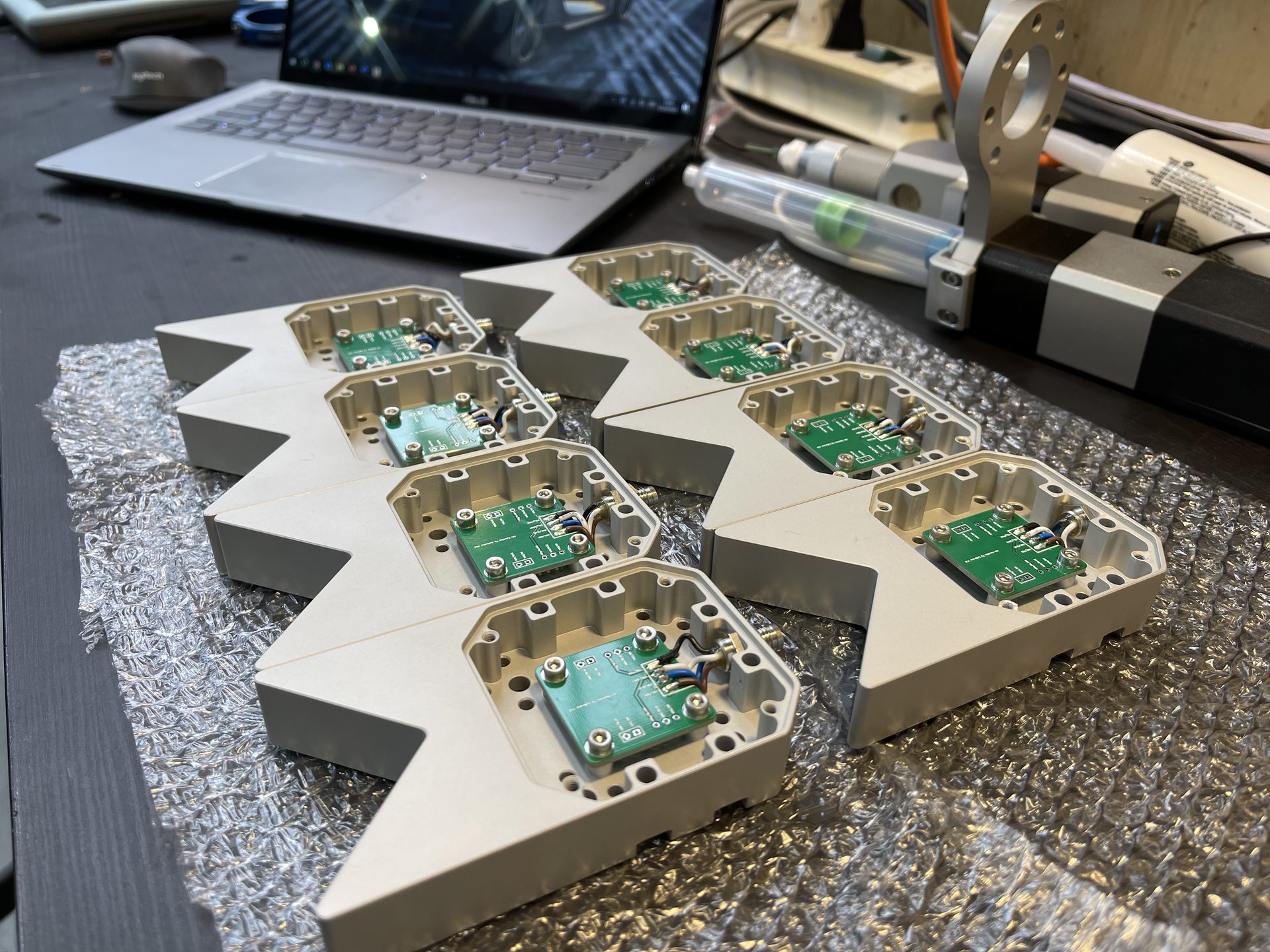 Electronics integration — custom PCBAs installed in CNC-machined aluminum housings. Each cavity is designed around the board geometry, thermal path, and connector access.
Thermal management. The dispensers operate continuously on production lines. Motor coils generate heat. Electronics generate heat. The fluid being dispensed is temperature-sensitive. Thermal design was not an afterthought — the mechanical housing, component placement, and duty cycle limits were co-designed to keep critical temperatures within operating range without active cooling. No fans. No heat sinks hanging off the side. The thermal path is the structure.
Production test. Every unit ships with a test protocol that validates motor performance, sensor calibration, communication integrity, and safety interlock function. The test fixtures were designed alongside the products — not bolted on after the first production run revealed yield problems. Custom test firmware exercises every subsystem and logs results for traceability.
Supply chain. Custom motors and coils mean custom suppliers. Building a reliable supply chain for bespoke electromagnetic components — with consistent winding quality, insulation integrity, and magnetic performance — is its own engineering discipline. I qualified suppliers, defined acceptance criteria, and built incoming inspection procedures that catch defects before they reach the assembly line.
From prototype to product company
Company founded. First patent applications filed in Europe and the United States. Distributor network established — 50 partners across 30+ countries before the first product shipped. Go-to-market built in parallel with engineering, not after it.
First three dispensers launched: FD 400, FD HighV, SD 30/55. From blank page to shipping hardware in roughly one year. Not by cutting corners — by making architecture decisions early that enabled fast iteration on execution.
Product line expanded. FD 310 and AimPath URCap launched. Relocated to Alfa Laval Innovation House in Copenhagen, Denmark.
Platform generation. AirBox and TCP Calibration Tool launched. The AirBox unified dispensing control into a single product serving multiple application types. Capital injection and new shareholders.
Global expansion. US customer support centre established. Market presence expanded from European base to worldwide operations.
What this demonstrates
This is what 0→1 looks like when the engineering is right.
You can go from no product and no team to a certified, patented, globally distributed product line in under five years — if the architecture decisions are correct from the start, if the custom engineering is done at the right level of abstraction, and if the product development and go-to-market are run in parallel rather than in sequence.
Every dispensing tool in the AimRobotics lineup exists because someone made a specific decision about what to make custom and what to buy. The motors are custom because off-the-shelf couldn’t fit. The coils are custom because generic windings couldn’t meet the control bandwidth. The PCBAs are custom because no existing board handled the combination of motor drive, sensing, communication, and safety required in this form factor.
None of that is visible to the end user. They see a tool that mounts on their robot, connects with one cable, and dispenses fluid with precision they couldn’t achieve before. That’s the point.
Read more about the work behind this
Building a hardware product that needs custom motors, custom electronics, or custom control systems?
I’ve done it — from patent filing through EMC certification to factory floor deployment.
Start a conversation